When I do birth reflections many people ruefully tell me they don’t remember things. They can feel bad about this. They say ‘it’s a bit of a blur’ apologetically, as if they should have cared more or tried harder. Especially the first few hours after birth can feel hazy, fragmented and gone.
I get wanting to hold on to it all because these children are everything to us. But childbirth is one of the most intense experiences the human body can go through. Physically, emotionally, and hormonally, it’s a high-stakes event.
I don’t remember parts of my birth (a three day extravaganza ending in an emergency cesarean which I have written about on the blog). Everyone I’ve looked after even if they had something straightforward, is in the same boat.
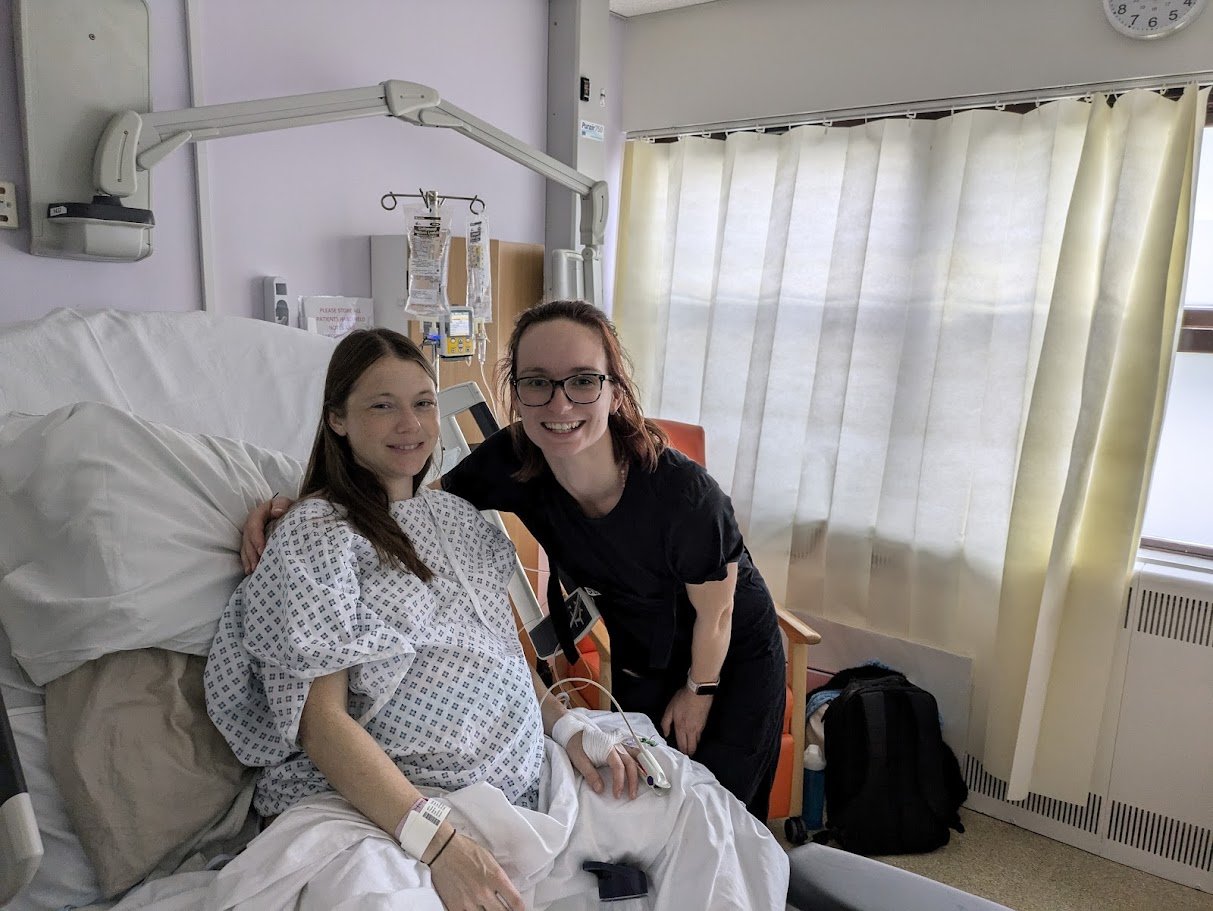
(btw the pohoto is me and my independent midwife Bethany…I’m so lucky. I actually had a great birth because I was so well supported. Even though it went objectively wrong, I don’t hold trauma because I got great care and I felt it all out as I went along.)
Why Does This Happen?
I think we all know that we remember birth differently but it’s worth exploring why memory can be affected during and after birth:
1. Hormones
During labour, your body releases endorphins and oxytocin amongst other chemicals. These help you cope with pain and support the birth process but you are on a different mental plane when having a baby. Even if you have an elective caesarean and no labour it’s still a trip and we give you loads of artificial oxytocin to help your uterus contract back down. It’s not a normal day hormonally. All of this makes the experience hard to remember.
2. Pain and physical exhaustion
Labour is physically demanding, and the early postnatal period is all but garunteed to be a sleep deprived time. Both pain and exhaustion can make it harder for the brain to encode memories.
3. Trauma or unexpected outcomes
If your birth didn’t go as planned, your brain may process parts of it differently. This doesn’t always mean trauma but when expectations and reality don’t align, it can affect how the experience is remembered. Also you may have made decisions legally and technically but still feel like you didn’t have a choice. It’s hard to process that and it can make memory around the time hazy.
Other Things to Consider:
We Don’t Remember Life Like a Timeline
We don’t usually remember our lives hour-by-hour, even on completely ordinary days.
We remember feelings, snapshots, a general sense of how things went.
Birth is no different, except it’s far more intense.
So instead of a neat, linear memory, what you often get is a kind of blurry outline.
But You Still Deserve to Understand Your Birth
Just because it’s normal not to remember everything doesn’t mean you shouldn’t have clarity about what happened.
Every birth matters, to you, your family, your culture and the wellbeing of women and birthing people. I honestly believe this last part, how you are treated during birth is an excellent way of ‘taking the temperature’ of a society’s attitude towards women.
This is where birth reflections can be incredibly helpful.
You can:
Go through your notes with a midwife
Ask the questions that are still lingering
Fill in the gaps
Make sense of decisions and events
Some hospitals offer these for free, or you can see an independent midwife (like me) who offers them in your home.
Why Piecing It Together Matters
I’m a midwife not a mental health professional, but I’ve read really good evidence I’ve read around this (see Harber and Pennebaker 1992 ‘Overcoming Traumatic Memories’). But also I have experience as a midwife and a mother and I know understanding it all helps.
When something feels overwhelming or traumatic, the brain struggles more if the story is incomplete.
The open loops start to take up energy:
Did that happen?
Why did that happen?
Could I have done something differently?
What does it mean for me or my baby?
Having a clear, linear narrative helps your brain process and settle the experience.
It closes those loops.
I love doing birth reflections and I think that is apparent while you have one.
See here for what I offer.
